
Hacking event - 2nd May
Hacking Event 2025: Students Driving Real-World Innovation
About the Event
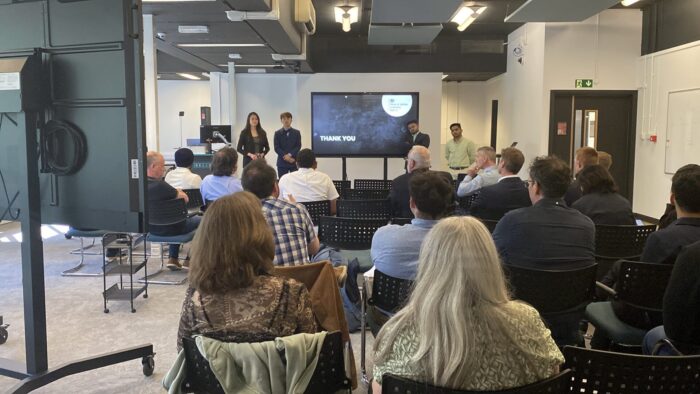
On 2 May 2025, the University of Leeds hosted its annual Hacking Event at HELIX, the University’s innovation hub. The event marked the culmination of the Problem Hacking module, developed and led by Dr Richard Tunstall, and brought together students, industry professionals, and public sector partners.
The module, now in its second year, challenges students to work in interdisciplinary teams to solve live problems set by organisations such as the Department for Transport (DfT) and the Ministry of Defence (MOD). Delivered in collaboration with the Common Mission Project, it places students in a high-stakes, real-world environment where their ideas have the potential to create genuine impact.
Student Experience
For many, the Problem Hacking module has been a highlight of their degree. Students spoke of the value of working directly with public sector partners and seeing their ideas taken seriously:
The real-world problem focus and direct collaboration with industry professionals made this module exceptionally valuable. Working on actual challenges faced by the Department for Transport provided practical context that theoretical coursework often lacks.
(Student quote)
“It was an incredible experience to present in front of the actual users who will be impacted by our work. Seeing how engaged and excited everyone was—and how quickly ideas were validated and taken further—really made us feel proud and accomplished.
(Student quote)
The Hacking Event itself gave students the opportunity to present their solutions to an audience of peers, faculty, and senior representatives from the MOD and DfT. For many, it was their first experience of pitching to decision-makers in such a high-profile setting.
Spotlight on a Team Project
 One standout group worked with the Defence School of Transport (DST) on the challenge of improving feedback systems for instructors, students, and support staff. Their project, “Sharing is Caring: Improving the Feedback Process for DST Staff and Students”, involved over 50 stakeholder interviews and an in-person site visit in April.
By engaging directly with those who use the system, the team proposed new ways to strengthen feedback culture, improve the quality of data collected, and ensure insights were acted upon. Their ideas were well received at the Hacking Event, where their final presentation demonstrated how practical innovation can improve training and communication in a large-scale defence setting.
The project didn’t end there. In June, the team was invited back to DST to present their proposals directly to senior leadership, who expressed strong intentions to adopt their recommendations.
Both study visits to DST were incredibly rewarding. They allowed us to understand the problem environment firsthand and present our solutions directly to decision-makers who were ready to implement them. (Leeds University Business School website)
Impact Beyond Leeds
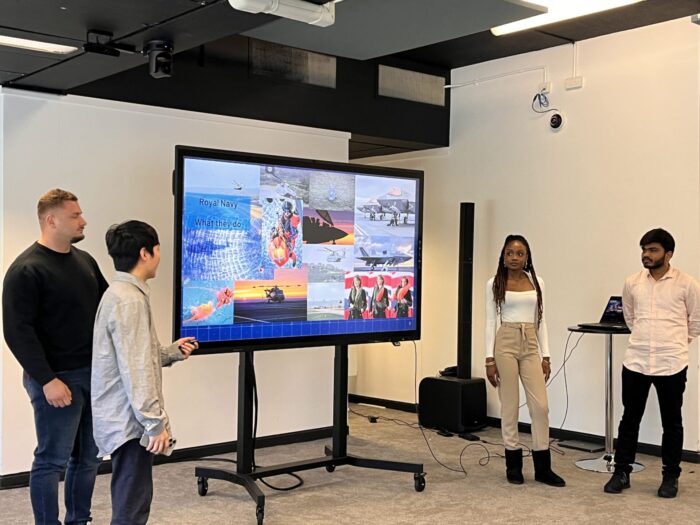
The event also highlighted the wider impact of the Problem Hacking module. At the Common Mission Project’s annual showcase in London, Leeds students presented alongside peers from King’s College London and Imperial College London. Leeds teams were shortlisted for the Outstanding Student Team award, while Dr Tunstall was nominated for Outstanding Contribution to Student Experience.
The Defence Innovation Accelerator (London Tech Bridge) praised the Leeds Navy team’s performance, recognising their innovative approach and strong presentation. Two Leeds students have since been invited to present their work to senior leadership at the Defence School of Transport and to an RAF innovation section, while two other teams will share their results with the Department for Transport in September 2025.
Leeds’ impact continues to grow, with a previous student team also being profiled as the main case study in the Common Mission Project’s annual report.
Looking Ahead
The 2025 Hacking Event demonstrated the value of experiential learning that connects students with real challenges and real partners. It showcased how University of Leeds students can bring fresh insights, creativity, and rigour to pressing public sector issues, while developing leadership and problem-solving skills that will define their future careers.
Quotations and information on this page have been adapted from the Leeds University Business School website.